Cats Dogs Doodles: A Designer’s Real-World Embroidery Review
First Impressions: Playful, Not Precious
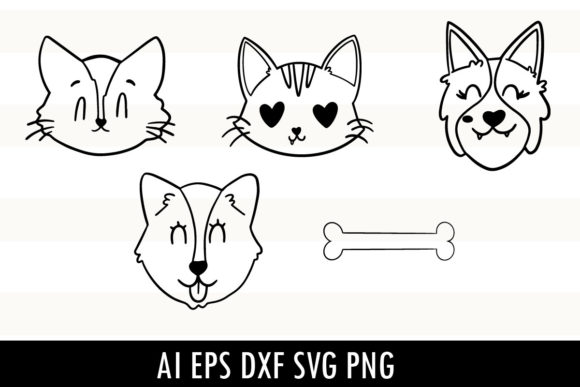
Opening Cats Dogs Doodles feels like flipping through a sketchbook left on a sunlit studio table—loose, lively, and full of personality. The five designs (two cats, two dogs, one dog bone) aren’t hyper-realistic or overly polished. Instead, they lean into hand-drawn charm: slightly uneven outlines, friendly proportions, and that effortless “doodle” rhythm in the line work. This isn’t a design set built for gallery wall seriousness—it’s made for the front pocket of a denim apron, the corner of a linen tea towel, or the chest of a soft organic cotton baby onesie. It sets an immediate tone: approachable, warm, and quietly confident in its simplicity.
A Real Project Test: Custom Embroidered Tote Bags for a Local Pet Boutique
Last week, I used Cats Dogs Doodles to embroider a batch of canvas tote bags for a small pet boutique launching their spring collection. We chose the smaller cat design (about 3" wide) centered on the front panel, stitched in muted sage green thread on natural unbleached canvas. The result? Instant recognition, zero confusion—and genuine smiles at the register. Customers didn’t just see “a cat.” They saw *their* cat. That’s the quiet strength of this set: it invites projection, not scrutiny. The doodle style avoids rigid breed specificity, making it inclusive across breeds, ages, and even species—those two dogs read equally well as terriers, pugs, or scruffy mutts.
Where It Shines (and Where It Asks for Thought)
Cats Dogs Doodles performs beautifully on medium-weight, stable fabrics—think cotton twill, canvas, linen blends, and midweight sweatshirt fleece. On a structured tote bag or a relaxed-fit crewneck sweatshirt, the outlines hold clean lines, and the open areas between shapes let the fabric breathe. As a machine embroidery design, it avoids dense fill stitch traps—no heavy satin-stitched eyes or overworked paws to snag during wear or washing. That makes it ideal for baby embroidery, personalized gifts, and everyday apparel where durability matters.
It also works smartly for small business use. As an embroidery file, it scales cleanly. I tested it at 2.5", 3.5", and 4.5"—all retained legibility without distortion. That flexibility means you can use the same dog bone as a subtle tag on a handmade dog bandana *or* enlarge it for a bold patch on a denim jacket. For Etsy sellers and craft fair vendors, that versatility is gold: one digital embroidery file supports multiple product tiers, from low-cost tea towels to premium embroidered pillow covers.
Use With Care: Texture, Scale, and Surface Matter
This isn’t a one-size-fits-all embroidery file—and that’s honest, not limiting. On highly textured fabrics (like bouclé or thick terry cloth), fine line details—especially in the cat whiskers or bone grooves—can blur. On stretchy knits (think lightweight t-shirts), stabilizer choice becomes non-negotiable; a lightweight cutaway paired with tear-away worked best in my tests. And on dark fabric? Don’t skip the test stitch in your intended thread color. Some lighter doodle strokes disappear if contrast is too low—what reads clearly in navy on white may vanish on charcoal unless you adjust thread saturation or add a subtle underlay.
Curved surfaces—like caps or curved pillow edges—require extra attention. The dog bone’s straighter lines adapted well, but the more fluid cat silhouettes needed slight repositioning and hoop rotation to avoid distortion. Also, avoid cramming these into tiny hoops (<3"). The negative space around each design is part of its charm; compressing it loses the breathing room that makes Cats Dogs Doodles feel so light and intentional.
Design Assets That Build Trust
Customers don’t buy “graphics”—they buy feeling, fit, and finish. When a client orders a custom embroidered blanket with a Cats Dogs Doodles motif, they’re trusting you to deliver something that feels handmade, not mass-produced. This set delivers that because it doesn’t try to be everything. Its modest detail level means fewer dropped stitches, cleaner trims, and consistent results—even on home embroidery machines. That consistency builds repeat business. It also translates well into printable mockups: the clean outlines pop in black-and-white previews, helping Etsy sellers showcase products without relying on heavy photo editing.
Practical Designer Notes Before You Stitch
- Always test first—on scrap fabric matching your final project’s weight and stretch.
- Check thread color contrast against both light and dark backgrounds before stitching the final piece.
- Review stitch density: Though not overly dense, confirm no tight clusters risk puckering on delicate fabrics like rayon or thin cotton voile.
- Confirm hoop size: These designs are likely optimized for standard 4x4 or larger hoops—verify before loading.
- Inspect small details: Whiskers, bone notches, and ear tips are subtle—zoom in digitally and stitch a sample to ensure clarity.
- Use proper stabilizer: Medium-weight cutaway for knits, tear-away for stable wovens, and optional topping for napped fabrics.
- Confirm licensing: Since this is marketed as a Crafts resource and Graphics asset, verify whether commercial use (e.g., selling finished embroidered patches or digital resale) is permitted before scaling for your craft business.
Final Thought: Charm With Intention
Cats Dogs Doodles won’t replace photorealistic pet portraits—but it wasn’t meant to. It fills a different, essential niche: the joyful, repeatable, stitch-friendly motif that turns functional items into keepsakes. Whether you’re an apparel decorator building a small shop product line, a hobbyist making holiday embroidery for family, or an Etsy seller curating a cohesive bundle of digital embroidery files, this set offers real utility wrapped in warmth. It reminds us that sometimes the most effective design isn’t the most detailed—it’s the one that leaves room for connection, memory, and a little everyday magic.